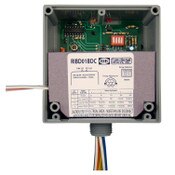
What a Time Delay Relay Does
A time delay relay is a control relay that switches its output contacts after a set time interval rather than instantly when it receives power or a control signal. Depending on the model, it can delay turning a circuit on (delay-on-make), delay turning it off after the signal drops (delay-on-break), or run through several timing functions selectable in one unit. In most applications, the relay doesn't carry motor-load current directly; it switches a control circuit that operates a contactor, starter, or other load-switching device.
How To Choose a Time Delay Relay for Your Application
Match three things before ordering: the coil voltage your control circuit runs on, the contact configuration and current rating the load requires, and the timing function the application calls for. Getting any one wrong means a relay that either won't accept your control signal or can't safely switch the connected load.
Coil Voltage
We stock time delay relays across common control voltages. This includes dedicated single-voltage models and universal-input versions built to accept a range of voltages in one part, which are useful when a 24V time delay relay needs to cover a broader application without swapping parts. Match the relay's coil voltage to your control circuit exactly; a mismatch means the relay won't operate, or won't operate safely.
Contact Configuration and Load Rating
Contact type matters as much as voltage. Our time delay relays are available in SPDT and DPDT configurations, with current ratings and low-voltage dry-contact-input options that vary by model. Confirm the switched load's current draw against the relay's contact rating before ordering. Undersizing a relay's contacts is a common cause of premature relay failure.
Timing Function
Time delay relays aren't all built for the same timing behavior. Some units offer a single fixed function (delay-on-make or delay-on-break), while multi-function models let you select from several timing functions in the field. This is useful when one relay needs to cover several roles in a control panel or when the exact function isn't finalized at time of order.
Why Choose Energy Control Technologies
We carry time delay relays built for control-panel and equipment-sequencing work. Here's why contractors and engineers choose our products time after time:
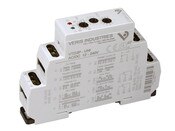
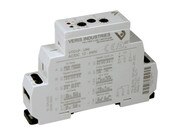
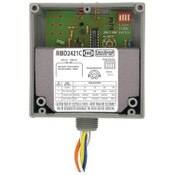
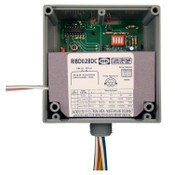
- Three manufacturers, one order: Veris, Functional Devices, and Johnson Controls, covering universal and fixed-voltage coil options, multiple contact configurations, and enclosed or open-frame housings.
- Manufacturer-sourced specs: Every voltage, contact rating, and function count comes from the manufacturer's own product listing, not a generic description.
- Two ways to buy: Order online for in-stock parts, or route through a quote request for project pricing on larger control-panel builds.
Need Help Choosing a Time Delay Relay?
For a control-panel build, multi-unit order, or help matching a relay's voltage and contact rating to your application, submit a quote request or contact our sales team.
Contact UsTime Delay Relay FAQs
Is a time delay relay the same as a contactor?
No. A time delay relay switches a low-current control circuit. It's not rated to carry motor-load current directly. A contactor is a heavier-duty switching device that carries the current a motor or other load draws. In a motor control circuit, a time-delay relay commonly controls a contactor's coil rather than the motor itself, adding a timing function before the load-switching device. We carry lighting contactors separately for that heavier-duty switching role.
Is there a 120V time delay relay in your catalog?
Yes. Our catalog includes dedicated 120V models as well as universal-input relays that accept 120V within a wider voltage range. Confirm the exact coil voltage on the product listing before ordering, since a relay built for the wrong voltage range won't operate correctly on your control circuit.
How do I know if a time delay relay has failed?
Common signs include a connected load that no longer starts or stops on schedule, a relay that stays energized or de-energized past its set delay, or contacts that don't switch at all. Time delay relays don't typically fail gradually the way a motor or bearing does. A failed timing function usually shows up as equipment running on the wrong schedule.
Where can I find a time delay relay wiring diagram?
Each product listing in this category links to the manufacturer's own data sheet, which includes the relay's terminal and wiring diagram. Because a time delay relay is wired into a live control circuit, and improper wiring can prevent it from timing correctly or damage connected equipment, a licensed electrician or controls technician should install it by following the manufacturer's documentation and local code.